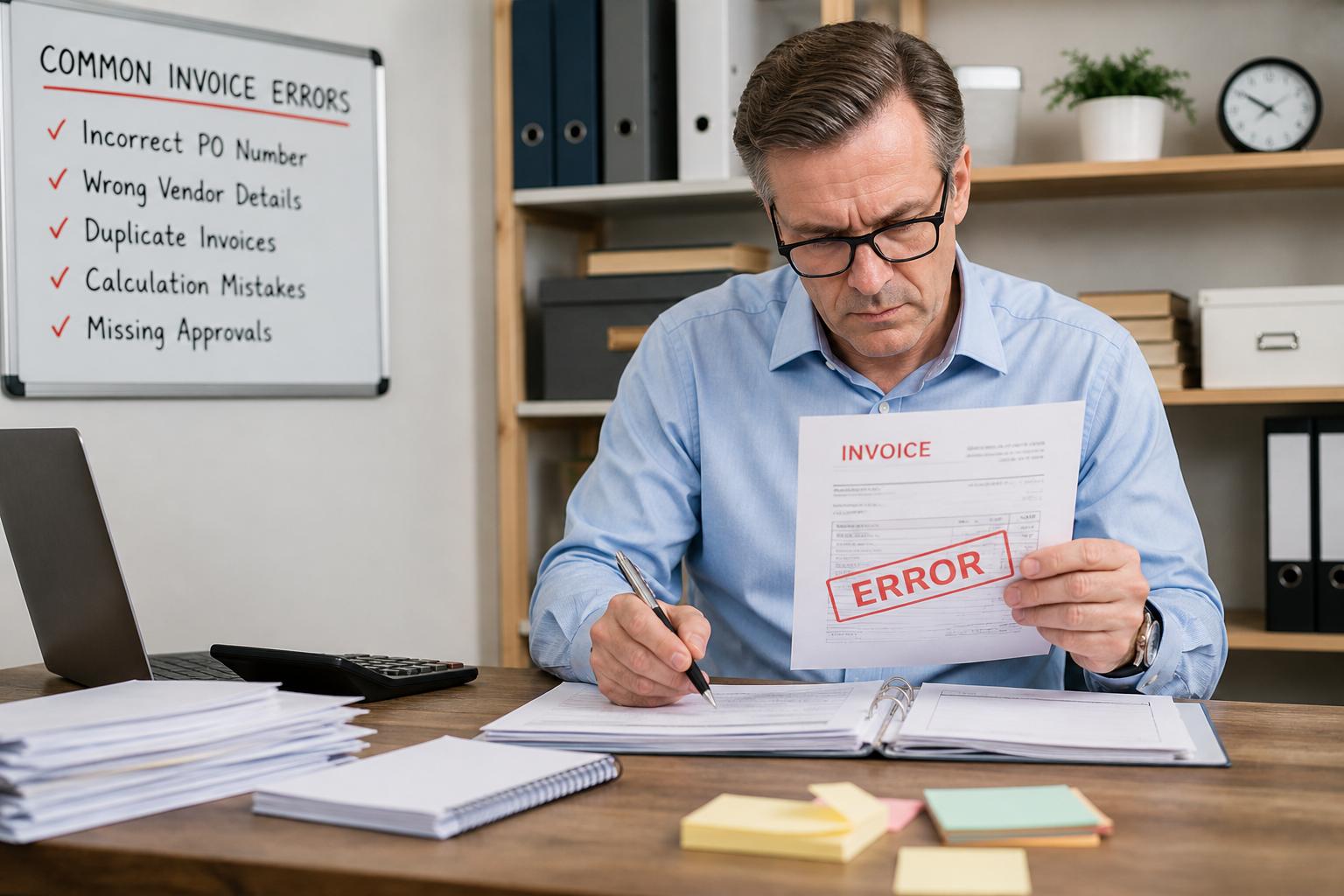
Invoice errors in accounts payable stem from manual data entry, disconnected purchase order workflows, missing or non-compliant tax details, and poor communication between procurement and finance teams. When staff type line items manually into accounting systems or sift through scattered email threads, typographical mistakes, mismatched unit prices, and duplicate submissions quickly multiply. In South African organisations, these discrepancies often escalate during VAT reconciliation with SARS or when unexpected power outages interrupt verification cycles. Correcting these breakdowns requires identifying root friction points within procurement workflows and replacing manual inputs with systematic controls.
The Primary Drivers of Accounts Payable Invoice Discrepancies
When multiple teams interact with suppliers without centralised oversight, billing inconsistencies follow. A clerk might capture an incorrect invoice total, or an external supplier might bill using an outdated rate sheet. Investing in modern procure-to-pay workflows eliminates the blind spots that allow these mistakes to reach payment runs.
The vast majority of accounts payable bottlenecks trace back to four operational triggers:
- Manual capture slips: Transposing figures, typing incorrect ledger codes, or misreading handwritten delivery notes.
- Broken three-way matching: Inconsistencies between the supplier invoice, the original purchase order, and the goods received note.
- Decentralised submission channels: Vendors emailing invoices to individual project managers rather than a single finance inbox.
- Incomplete billing information: Missing purchase order numbers, unregistered vendor addresses, or invalid 10-digit tax registration numbers.
Structural Flaws in Purchase Order and Billing Systems
Errors do not happen in isolation; they reflect broken handoffs between purchasing agents, warehouse receiving staff, and accounting personnel. When paperwork sits on desks or gets buried in overflowing inboxes, tracking the source of an error becomes tedious.
Mismatched Quantities and Contract Pricing
Suppliers frequently invoice for the entire order even when delivering partial shipments. If the receiving dock fails to record the actual count on the goods received note, accounts payable ends up settling for stock that never entered the facility. Similarly, suppliers sometimes apply standard list prices instead of the negotiated contract rates agreed upon during procurement.
Duplicate Billing and Disorganised Vendor Records
Duplicate invoices often slip into processing queues when vendors send polite follow-up statements that get captured as fresh claims. In other cases, companies maintain multiple profiles for a single supplier, perhaps under different trading names or branches, which disables built-in duplicate detection rules.
Common systemic breakdown points across corporate finance teams include:
- Stale master vendor files containing duplicate supplier profiles or obsolete banking coordinates.
- Unapproved price adjustments introduced by vendors without prior contract amendments.
- Unrecorded return of goods where credit notes fail to link to the open invoice.
Operational Friction Unique to South African Businesses
Operating in Cape Town and across the broader South African market introduces specific regulatory and infrastructure realities that complicate invoice processing. A simple typo on an invoice can trigger audits, delayed tax refunds, or vendor disputes.
Finance managers across the Western Cape regularly face distinct operational hurdles:
- Load-shedding disruptions that interrupt local server synchronisation and corrupt digital batch uploads during capture cycles.
- SARS compliance disputes arising when supplier invoices lack the mandatory details required for input VAT claims.
- Cross-border exchange rate fluctuations when importing equipment or services through the Port of Cape Town without fixed forward pricing.
Practical Controls to Eliminate Payment Inaccuracies
Eliminating errors does not require adding more approval layers that slow down operations. Instead, finance leadership must establish automated guardrails and strict validation rules. Integrating automated data extraction solutions removes human keystroke variance entirely, allowing accounting staff to focus on exception handling rather than repetitive data entry.
Finance directors can eliminate repetitive clerical errors by implementing three fundamental controls:
- Mandate strict three-way matching before releasing any commercial payment run.
- Establish tolerance thresholds that flag any price variance exceeding contract agreements by more than one percent.
- Standardise supplier onboarding protocols to verify banking details and tax credentials before issuing purchase orders.
Precision Solutions With S2P
Preventing invoice inaccuracies requires a clear connection between procurement, contract compliance, and financial settlement. At S2P, we help businesses throughout South Africa transform vulnerable accounts payable departments into automated, resilient operations. Our team designs reliable workflows that eliminate manual input traps, enforce strict three-way matching, and maintain accurate audit trails for SARS compliance. Direct your finance team to reach out via our contact form to schedule an operational assessment and streamline your procurement cycle.
Frequently Asked Questions
How does three-way matching prevent invoice discrepancies?
Three-way matching compares the line items, quantities, and prices on a supplier invoice against the purchase order and the goods received note. If any figure fails to align within set tolerance limits, the system holds the invoice for manual review before payment approval, stopping overbilling and phantom charges.
Why do duplicate invoices bypass standard internal audits?
Duplicates slip through when a vendor submits the same bill through different channels, such as email and postal mail, or when minor variations exist in the invoice number. Duplicate vendor profiles within an accounting database also blind legacy accounting software to identical billing amounts.
What SARS requirements must a valid tax invoice meet in South Africa?
Under SARS regulations, a valid full tax invoice for transactions exceeding R5,000 must include the phrase Tax Invoice, the supplier and recipient registered names and VAT numbers, an individual serialised number, an accurate description of goods or services, the date of issue, and a clear breakdown of the 15 percent VAT charge.
How quickly can automation reduce accounts payable error rates?
Organisations typically see an immediate drop of up to ninety percent in capture errors within the first month of deploying automated optical character recognition and automated matching rules. Processing times shrink from weeks to hours while completely eliminating manual entry mistakes.
Leave a Reply