Category: S2P

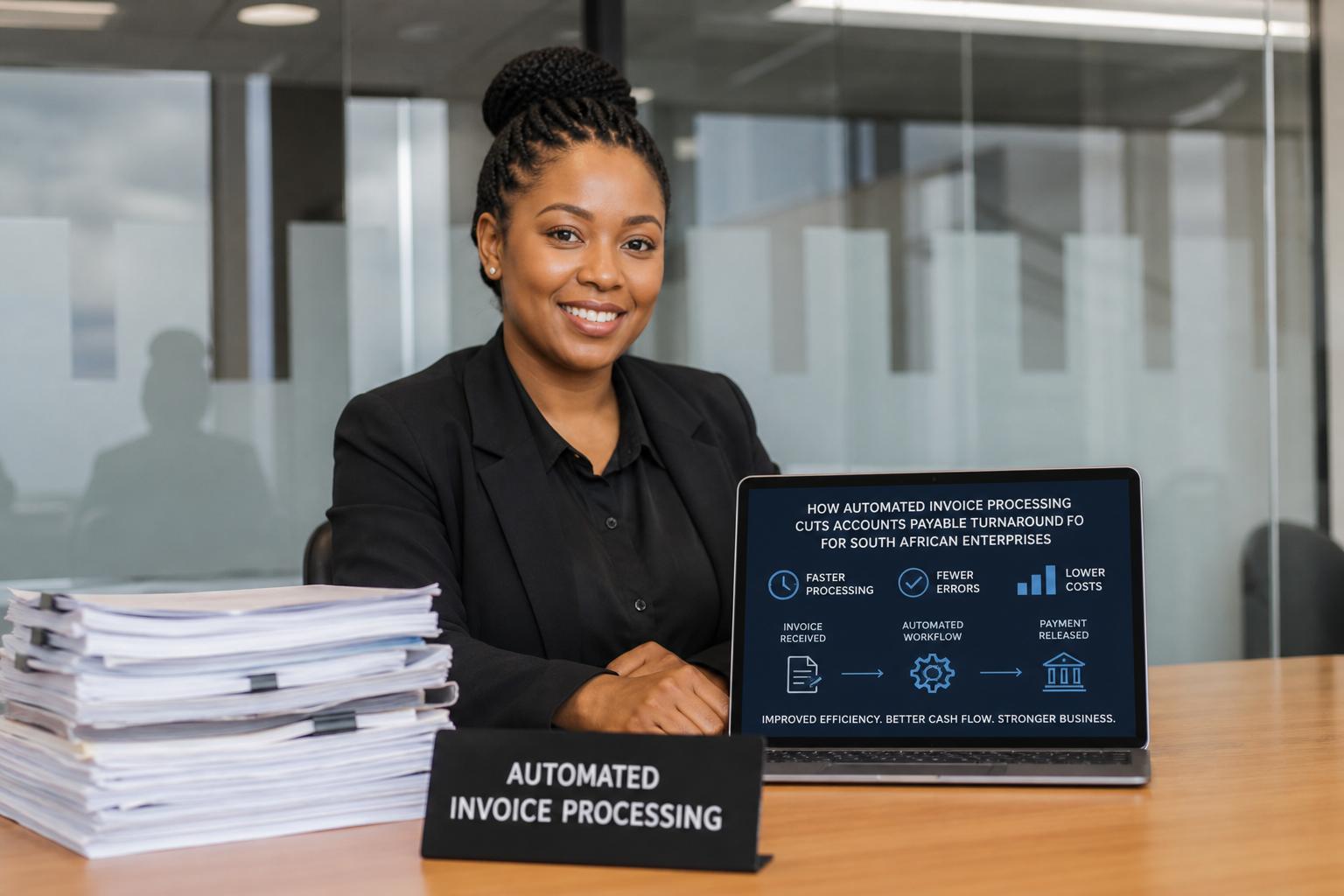
  • How Automated Invoice Processing Cuts Accounts Payable Turnaround for South African Enterprises

    How Automated Invoice Processing Cuts Accounts Payable Turnaround for South African Enterprises

    Automated invoice processing reduces accounts payable processing times for enterprise businesses in South Africa from weeks to hours by eliminating manual data entry, digitising document capture, and executing touchless three-way matching against purchase orders and goods receipts notes. By replacing manual administrative hand-offs with machine learning and automated approval routing, financial teams process complex high-volume invoices instantly while ensuring strict compliance with South African Revenue Service (SARS) tax invoice standards.

    Eliminating Manual Data Capture Bottlenecks

    Large South African corporations handle thousands of supplier invoices monthly across multiple formats, from scanned PDFs to paper slips. Modern invoice intelligence automatically extracts line items, VAT numbers, and banking details with high accuracy. Implementing automated invoice processing in South Africa removes the friction of manual spreadsheet typing, allowing finance teams to avoid backlog pile-ups during month-end closes.

    Automated extraction eliminates processing delays across several daily accounts payable tasks:

    • Instant ingestion of digital documents from dedicated supplier inboxes without manual file handling
    • High-speed optical recognition that captures line-item descriptions, quantities, and Rand values
    • Automatic validation of supplier VAT registration numbers directly against tax rules

    Accelerated Verification and Approval Workflows

    Traditional approval chains stall when paper documents sit on managers desks or get lost in email threads. Automated systems apply rules-based workflows to route invoices straight to designated budget holders based on cost centre, threshold limits, or project codes.

    Automated Three-Way Matching

    Manual reconciliation between purchase orders, delivery notes, and tax invoices consumes hours of departmental time. Automated platforms compare line items, quantities, and pricing instantly. When values match within acceptable tolerances, the system clears the invoice for payment scheduling without requiring human intervention. Understanding the wider AI-powered invoice processing benefits helps enterprise finance leaders identify where exceptions occur so staff only touch mismatched documents.

    Modern matching engines handle standard validation checks automatically:

    • Comparing purchase order values against supplier billing totals
    • Cross-referencing goods receipt records to confirm physical delivery at local warehouses
    • Flagging price discrepancies, duplicate billings, or missing tax invoice identifiers for rapid review

    Managing Local Operational and Regulatory Pressures

    South African enterprises face unique operational hurdles, such as load-shedding disruptions and fluctuating supply chain timelines. When power outages or connectivity drops halt office-based manual review, cloud-based automated systems maintain continuous background queues. Furthermore, meeting strict SARS requirements requires rigorous audit trails and rapid dispute resolution with domestic vendors.

    Enterprise automation protects operational momentum through several key mechanisms:

    • Cloud-hosted queues that continue ingesting and parsing supplier invoices during local infrastructure outages
    • Centralised audit logs that record every approval, edit, and payment status change for tax compliance
    • Automated vendor notification systems that immediately request corrected invoices when tax-required data is missing

    Precision Solutions With S2P

    S2P equips South African enterprise finance teams with intelligent tools designed to cut accounts payable cycle times, eliminate manual errors, and maintain strict governance. By replacing slow manual entry with automated document reading, matching, and ERP synchronisation, your organisation speeds up supplier settlements and captures early settlement discounts. Connect with S2P to transform your accounts payable operations into a lean, efficient finance hub.

    Frequently Asked Questions

    How much time can an enterprise save by automating invoice processing?

    Most enterprise businesses cut their average invoice turnaround time by 60 to 80 percent, taking standard invoice lifecycles down from 15 to 20 days to less than two days.

    How does automated invoice processing support SARS compliance?

    The software validates necessary tax invoice components, including the registered business name, address, VAT number, and clear breakdown of standard-rated supplies, ensuring audit readiness before payments post to the general ledger.

    Can automated accounts payable systems integrate with existing ERP platforms?

    Yes, modern platforms integrate directly with major ERP systems like SAP, Oracle, and Sage, automatically synchronising master vendor records, purchase orders, and general ledger codes.

    What happens when an invoice contains errors or pricing discrepancies?

    The platform isolates the exception and routes an alert directly to the relevant procurement or finance officer with the discrepancy highlighted, allowing rapid resolution without delaying the rest of the payment batch.

  • Why Finance Teams in South Africa Are Adopting Automated Invoice Processing

    Why Finance Teams in South Africa Are Adopting Automated Invoice Processing

    South African finance teams are adopting automated invoice processing to eliminate manual capture errors, maintain strict SARS tax compliance, and connect incoming supplier data directly into enterprise resource planning platforms without operational friction. By removing manual touchpoints, accounts payable departments keep supplier workflows moving even during power cuts or remote work shifts, ensuring suppliers get paid on time while protecting company cash flow.

    The Operational Pressure on South African Accounts Payable Teams

    Managing high-volume supplier accounts across South Africa comes with distinct logistical and economic pressures. Finance teams frequently face backlogs caused by unstructured supplier PDFs, disparate email threads, and manual three-way matching against purchase orders. When paper or emailed documents sit in inboxes waiting for manual review, payment cycles stall and early-settlement discounts slip away.

    Implementing automated invoice processing in South Africa allows organisations to bypass manual data entry entirely. Modern optical character recognition and machine learning capture line items accurately, standardising billing data before it ever hits an approval queue.

    Accounts payable departments experience several immediate operational advantages when they modernise these workflows:

    • Automatic validation of vendor VAT registration numbers against current South African Revenue Service requirements
    • Zero data loss during unexpected office interruptions or regional load-shedding schedules
    • Elimination of double captures and duplicate payments across overlapping supplier accounts
    • Instant matching against purchase orders and goods received vouchers

    Seamless ERP Integration Without Custom Code Headaches

    A major friction point for financial controllers is getting invoice data into core business systems like SAP, Oracle, Microsoft Dynamics, or Sage. Manual rekeying between siloed accounts payable software and an ERP wastes hours and introduces costly transcription errors.

    Modern automation platforms bridge this gap through pre-built connectors and open application programming interfaces. Instead of requiring costly custom middleware, the software extracts header and line-item details, normalises the data, and posts entries directly into the general ledger with zero manual intervention.

    Real-Time General Ledger Visibility

    When invoices feed straight into your ERP, accruals update instantly. Financial managers gain immediate visibility into month-end liabilities without waiting days for accounts payable clerks to process backlogged paper stacks. This visibility sharpens cash management and eliminates unexpected end-of-quarter surprises.

    Automated Three-Way Matching

    Enterprise systems depend on precise matching to maintain audit readiness. Automated platforms execute three-way matches by comparing the supplier invoice, the internal purchase order, and the warehouse delivery note. Discrepancies generate automatic exception alerts for review, while matching invoices move straight to payment scheduling.

    Streamlining Vendor Workflows and Supplier Relationships

    Supplier relationships sour quickly when invoices go missing or payments arrive late. Traditional approval routes rely on email ping-pong between branch managers, cost-centre owners, and accounts payable staff. If an approver takes leave or misses an email, the entire supplier pipeline freezes.

    Automated approval workflows route documents based on preset business rules such as invoice value, department, or project code. Exploring the core ai-powered invoice processing benefits shows how intelligent routing cuts approval turnarounds from weeks to hours.

    Finance leaders build stronger supplier trust by executing key workflow improvements:

    • Routing invoices automatically to designated approvers based on financial delegation of authority limits
    • Providing self-service visibility so vendors can check payment stages without contacting finance staff
    • Accelerating dispute resolution through automated variance detection on unit pricing or delivery quantities
    • Enabling early payment capture to negotiate preferential supplier settlement terms

    Enhancing Fraud Detection and SARS Compliance

    Invoice fraud remains a persistent risk in South Africa, ranging from altered bank details to ghost vendor billing. Manual sampling cannot catch sophisticated discrepancies hidden inside hundreds of monthly invoices. Automated systems apply rules-based checks against every incoming document before it enters the payment run.

    Modern automation platforms enforce critical financial safeguards across the entire accounts payable pipeline:

    • Verifying vendor bank account details against approved master data to prevent business email compromise
    • Confirming mandatory tax invoice fields, including valid tax numbers and physical business addresses
    • Tracking every touchpoint with an immutable digital audit trail for external auditors
    • Flagging sudden changes in supplier banking details for secondary management sign-off

    Modernise Accounts Payable With S2P

    Eliminating manual accounts payable friction gives your finance team the time they need to focus on strategic cash management and supplier negotiation. The intelligent automation suite from S2P automated accounts payable platform delivers high-precision document capture, touchless ERP integration, and ironclad approval controls designed for South African enterprises. Contact the team today to schedule an operational assessment and streamline your vendor pipeline.

    Frequently Asked Questions

    How does invoice automation integrate with existing ERP platforms?

    Automated processing platforms connect directly with ERP systems such as SAP, Sage, Oracle, and Microsoft Dynamics through secure APIs or native connectors. Once an invoice is scanned and validated, the data posts automatically to the corresponding accounts payable sub-ledger without manual re-entry.

    Can automated invoice processing detect fraudulent supplier banking details?

    Yes. The software checks incoming invoice bank details against your approved master supplier records. If a supplied bank account does not match the authorised master data, the system flags the invoice instantly and halts payment until verified.

    How does automation help with South African VAT compliance?

    The platform checks that incoming invoices meet all SARS requirements for valid tax documentation. It validates VAT registration numbers, confirms proper tax breakdowns, and ensures correct supplier and customer entity details are present before submitting for payment.

    What happens when an invoice does not match the purchase order?

    When line items, quantities, or prices do not match the purchase order or goods receipt note, the system triggers an exception workflow. It routes the invoice directly to the relevant procurement or department manager with highlighted variances for rapid resolution.

  • Compliance And BBBEE Requirements For Automated Invoice Processing In South Africa

    Compliance And BBBEE Requirements For Automated Invoice Processing In South Africa

    Automated invoice processing systems in South Africa must enforce strict compliance with Section 20(4) of the Value-Added Tax (VAT) Act, maintain five-year electronic record archives under the Tax Administration Act, and automatically extract supplier Broad-Based Black Economic Empowerment (B-BBEE) credentials for preferential procurement reporting. Without these core validation rules built directly into your workflow, accounts payable teams face disallowed input tax deductions, failed SARS audits, and degraded B-BBEE scorecard ratings.

    Mandatory SARS Tax Invoice Compliance Rules

    South African tax legislation places the burden of proof squarely on the purchasing business to ensure every supplier document meets legal tax invoice standards before claiming input VAT. Modern systems running automated invoice processing in South Africa must validate incoming tax invoices against strict statutory line items before posting them to your general ledger.

    To prevent invalid VAT claims on transactions exceeding R5,000, your capture software must automatically check for specific mandatory details:

    • The explicit words ‘Tax Invoice’, ‘VAT Invoice’, or ‘Invoice’ positioned prominently on the document
    • The legal trading name, physical address, and 10-digit VAT registration number of both the vendor and your organisation
    • An individual serialised invoice number and the exact date of issue
    • A full, accurate description of the goods delivered or services rendered
    • A clear breakdown showing the total excluding VAT, the 15 percent VAT charge, and the total gross amount in South African Rand

    Automating B-BBEE Data Capture And Preferential Procurement

    Preferential procurement accounts for 25 points on the generic B-BBEE scorecard, making supplier classification tracking a core operational requirement rather than an afterthought. Integrating B-BBEE validation directly into accounts payable ensures that every Rand spent is matched to the vendor’s actual recognition level at the exact time of invoice approval. Leveraging the operational benefits of AI-powered invoice processing eliminates the scramble to collect compliance certificates during year-end verification audits.

    Validating Supplier B-BBEE Certificates Automatically

    Vendor recognition levels change frequently, and manual spreadsheet trackers often miss expired affidavits or altered status levels. An automated pipeline should cross-reference incoming invoices with your verified vendor master file and flag non-compliant suppliers before payment release.

    Your automated capture system must extract and track key procurement data points:

    • B-BBEE contributor level from Level 1 down to Level 8 or non-compliant status
    • Enterprise size category, specifically distinguishing between Exempted Micro Enterprises (EMEs), Qualifying Small Enterprises (QSEs), and Generic entities
    • Black ownership, Black female ownership, and designated group percentages
    • Certificate or sworn affidavit expiry dates with automated alerts triggered 60 days prior to lapse
    • Proof of Empowering Supplier status where required by specific sector codes

    Audit Readiness And Electronic Record Storage

    Under Section 29 of the Tax Administration Act, businesses in South Africa must retain accessible, readable copies of all tax records for a minimum of five years from the date of the relevant tax return submission. Optical character recognition (OCR) platforms must store invoices in tamper-evident digital formats that satisfy SARS audit scrutiny while adhering to the Protection of Personal Information Act (POPIA) regarding vendor banking data.

    Robust accounts payable systems maintain operational integrity through clear controls:

    • Immutable digital audit trails documenting exact timestamps for receipt, data extraction, approval, and ERP posting
    • Direct two-way and three-way matching against purchase orders and electronic goods received notes (GRNs)
    • Automated duplicate invoice detection based on supplier VAT numbers, invoice numbers, and line-item amounts
    • Role-based access permissions that protect sensitive vendor financial details and banking information

    Precision Solutions With S2P

    Managing South African tax standards and B-BBEE verification manually drains finance resources and exposes your enterprise to punitive audit penalties. S2P builds intelligent financial automation that validates SARS compliance, tracks preferential procurement scoring, and accelerates approvals seamlessly. Explore how S2P automated invoice software transforms your accounts payable workflow into an audit-proof asset.

    Frequently Asked Questions

    What makes an electronic invoice valid under South African tax law?

    An electronic invoice is valid under South African law if it contains all required Section 20(4) VAT Act details, is issued in South African Rand unless specifically approved otherwise, and is stored in an unalterable format that SARS auditors can inspect on demand.

    How does invoice automation improve B-BBEE scorecard reporting?

    Automation links line-item invoice expenditure directly to the vendor’s verified B-BBEE level, ownership status, and enterprise category in real time, preventing unverified spend and ensuring accurate recognition calculations during B-BBEE verification audits.

    How long must digitised invoices be stored according to SARS?

    SARS requires all financial records, including digitised and automated tax invoices, to be retained for at least five years from the date the corresponding tax return was filed. If an audit or objection is open, documents must be stored until the process concludes.

    Can invoice software detect expired B-BBEE certificates before payment?

    Yes, advanced accounts payable platforms monitor vendor master data against recorded certificate expiry dates and can automatically place invoices on hold or alert procurement teams when a supplier’s B-BBEE affidavit has lapsed.