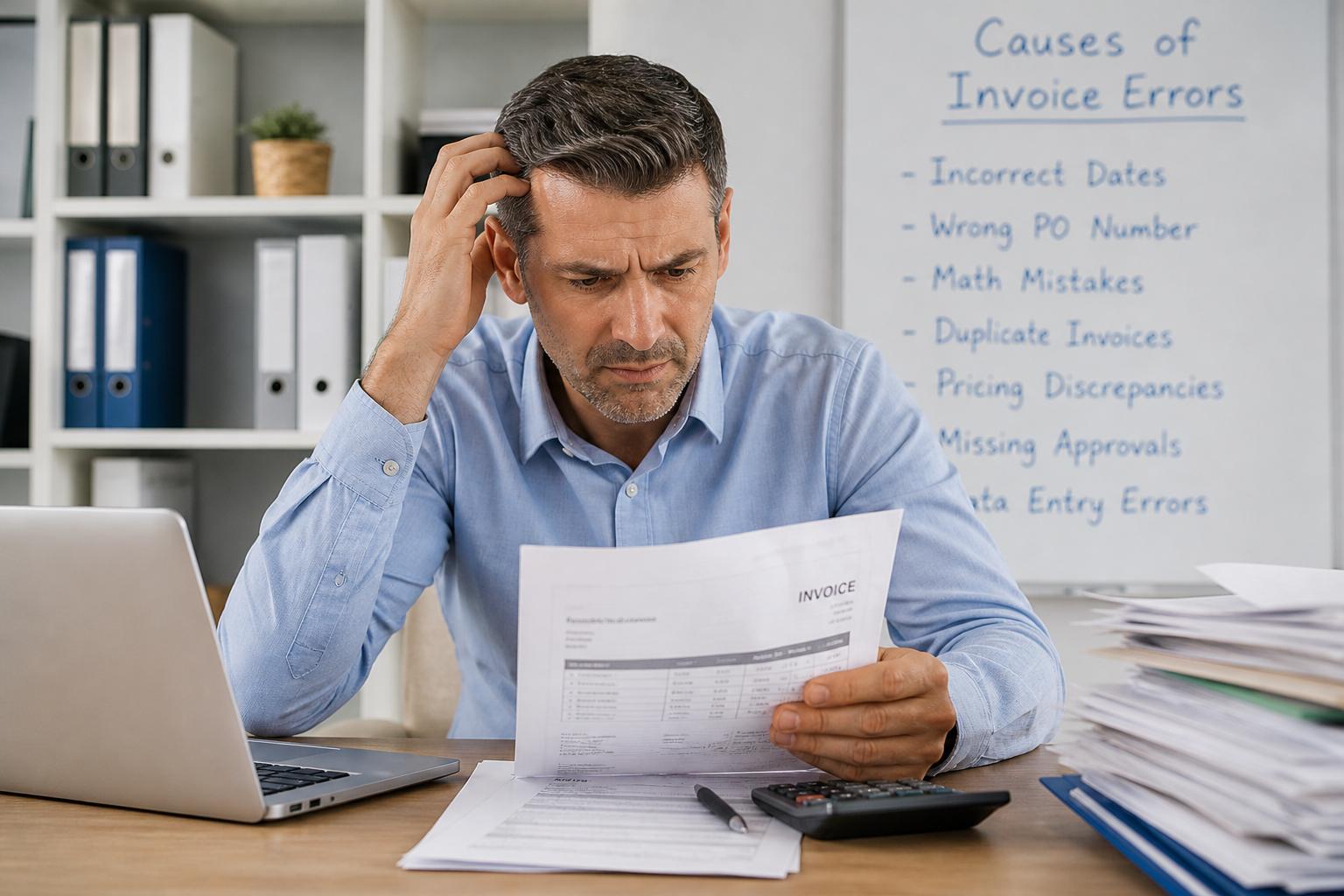
Invoice errors in accounts payable are primarily caused by manual data capture slips, discrepancies between purchase orders and receiving slips, duplicate vendor submissions, and unverified supplier details. In South African commercial hubs like Cape Town, these administrative issues often multiply when team schedules face municipal power shedding or when rapid supplier price adjustments outpace updated enterprise contracts.
Common Sources of Invoice Errors
In accounts payable, even minor clerical oversights lead to strained vendor relationships, erroneous disbursements, and lost early-settlement discounts. The root cause is rarely negligence; it is typically an outdated workflow dependent on manual scrutiny across disparate spreadsheets and physical files. Identifying these breakdown points allows organisations to plug financial leaks quickly.
Accounts payable teams encounter recurring friction points that trigger incorrect supplier disbursements:
- Keying mistakes where clerks transpose invoice totals, line quantities, or tax amounts during manual capture.
- Omission of statutory details, such as missing South African Revenue Service compliant VAT registration numbers or formal physical addresses.
- Discrepancies in unit pricing, freight charges, or currency conversions that do not align with original purchase agreements.
- Duplicate billing, occurring when suppliers submit invoices via multiple channels like email, post, and internal staff messages.
Manual Entry and Human Fatigue
When accounting clerks process hundreds of supplier invoices weekly, typographical errors become inevitable. Transposed figures, misspelled vendor names, and misclassified general ledger codes corrupt downstream financial reports. These keystroke blunders force finance teams to spend dozens of hours during month-end reconciliations tracking down small variance figures.
Three-Way Matching Failures
A breakdown in matching purchase orders, delivery notes, and supplier invoices accounts for a substantial share of billing errors. When receiving docks across the Western Cape accept stock without logging damaged cartons or short deliveries, accounts payable receives an invoice reflecting goods that never entered the warehouse. Paying against an unverified invoice without confirming physical receipt leads straight to cash loss.
Operational Breakdowns in the Approvals Process
Beyond basic input mistakes, systemic process bottlenecks create the ideal conditions for accounts payable oversights. Communication disconnects between procurement teams and operational managers frequently leave accounts payable teams guessing about authorisation.
Several systemic bottlenecks degrade transaction accuracy across the finance function:
- Unauthorised off-contract purchases initiated outside formal procurement channels without a matching purchase order.
- Stale vendor master files that retain outdated banking coordinates, old addresses, or expired tax clearance statuses.
- Delayed approval handoffs across department managers, forcing hasty, last-minute payment runs to avoid service cutoffs.
Supplier Master Data Degradation
Suppliers alter banking details, trading names, and contact people regularly. If your enterprise fails to update its vendor master record, invoices will bounce, be directed to incorrect ledger accounts, or risk fraudulent redirection. Maintaining rigid controls around vendor file updates is essential to prevent systematic payment errors.
Regional Operational Disruptions
Operating in Cape Town introduces specific operational realities. Intermittent load-shedding and sudden connectivity cuts can interrupt data batching between enterprise systems. When cloud accounting platforms or on-premise servers drop offline mid-entry, transactions frequently get re-entered twice, creating phantom duplicates that manual audits struggle to catch.
Practical Steps to Eliminate Processing Errors
Rectifying accounts payable inaccuracies requires moving away from manual spot-checks toward automated verification. By validating supplier information at intake, organisations can arrest errors before transactions reach the payment queue. Implementing our automated invoice matching systems allows businesses to cross-reference line items against contracts instantly.
Finance leaders can stabilise payment accuracy by instituting strict verification controls:
- Enforce strict purchase order rules so that no supplier invoice is approved without a pre-authorised reference number.
- Automate three-way matching to flag variance tolerances in unit pricing and delivered quantities instantly.
- Conduct routine audits of the vendor master file to archive dormant accounts and verify banking credentials.
- Standardise the submission channel by requiring all contractors and vendors to submit billing through a unified digital portal.
Precision Solutions With S2P
Eliminating invoice errors protects working capital and preserves supplier goodwill. At S2P, we design intelligent source-to-pay and procurement workflows that automate data ingestion, eradicate manual typing mistakes, and enforce rigorous verification across every invoice. Connect with our Cape Town consultation team to assess your accounts payable processes and secure your procurement pipeline.
Frequently Asked Questions
What is the most frequent cause of accounts payable invoice errors?
Manual data entry is the leading cause. When staff manually retype invoice numbers, line quantities, and banking information from paper or PDF documents into accounting software, typographical mistakes and omitted details occur consistently.
How does three-way matching stop billing inaccuracies?
Three-way matching verifies that the supplier invoice matches the purchase order and the receiving delivery note before payment is authorised. This ensures your company only pays for items that were properly ordered and physically delivered at the agreed price.
Why do duplicate invoice payments occur so often?
Duplicates usually occur when a vendor sends an invoice through multiple mediums, such as email and postal mail, or when an invoice is resent because of payment delays. Without automated duplicate-detection software, different staff members may process the same bill twice under slightly different references.
What makes an invoice legally compliant for VAT in South Africa?
Under SARS guidelines, a full tax invoice must state the words ‘Tax Invoice’, include the supplier and recipient names, addresses, and VAT registration numbers, display an individual serialised invoice number, record the date, describe the goods or services, and clearly specify the total cost with VAT broken out.
Leave a Reply