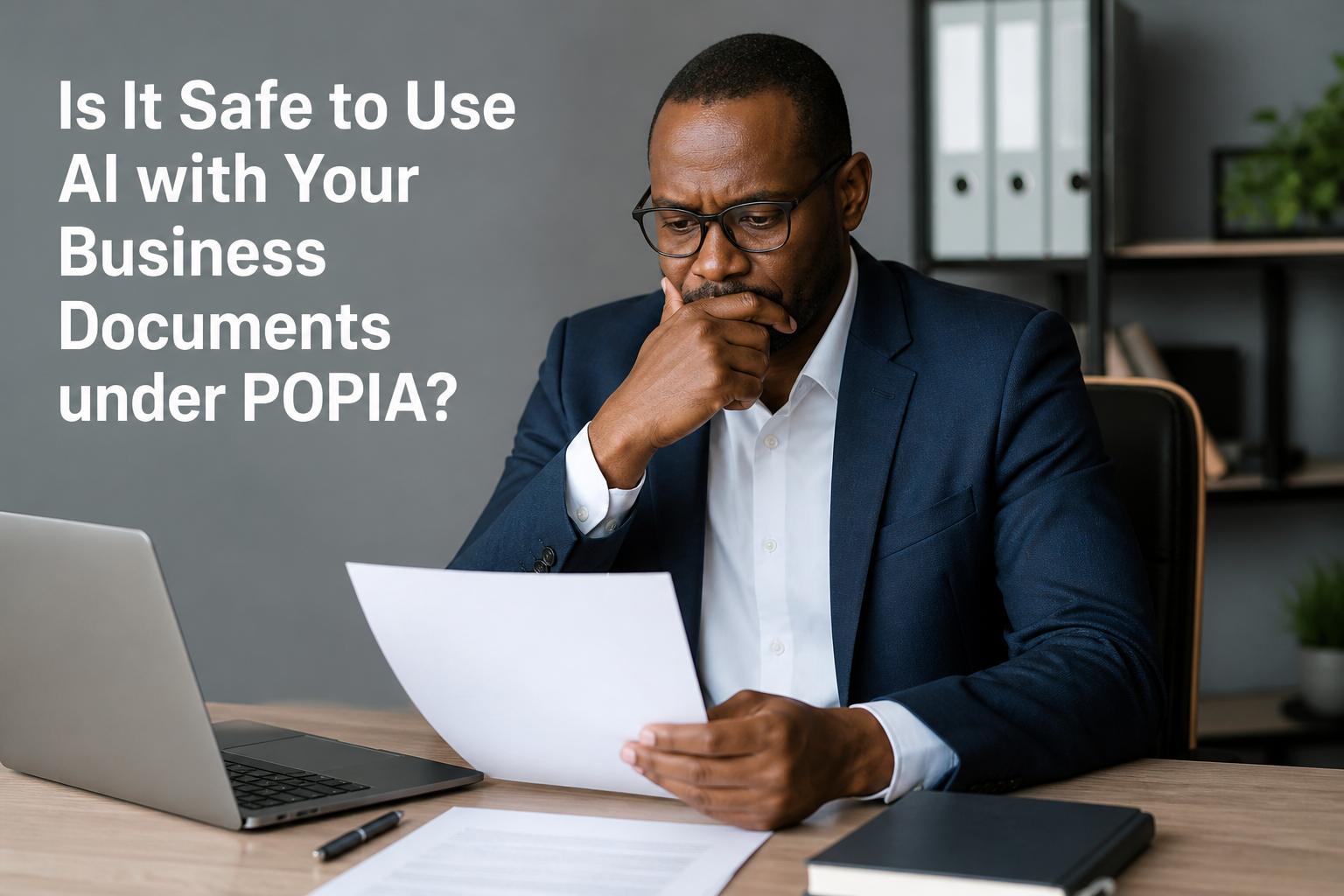
Using artificial intelligence tools with your business documents under POPIA is only safe if you operate private, enterprise-grade software governed by strict data processing agreements; feeding personal information into public, consumer-facing AI models violates South African privacy law. The Protection of Personal Information Act requires every responsible party to safeguard personal records against unlawful processing, loss, and unauthorized external exposure. Uploading confidential staff files, customer contracts, or payroll records into free public generators frequently exposes that data to third-party model training, leaving Pretoria businesses open to severe penalties from the Information Regulator.
Understanding POPIA Liabilities when Feeding Documents to AI
Under POPIA, your business remains the responsible party whenever you handle personal information, even when outsourcing analytical work to automated platforms. Passing files to an AI platform turns that software vendor into an operator. If that operator stores inputs on unencrypted offshore servers or reserves the right to reuse prompts for machine learning upgrades, you have compromised your statutory obligations.
Every company must evaluate these core compliance vulnerabilities before adopting generative tools:
- Uncontrolled model training that permanently integrates private customer data into public knowledge bases
- Cross-border information flows that lack adequate legal protections or explicit subject consent
- Breaches of data minimization rules caused by dumping entire unredacted files into chat prompts
- Failure to alert both affected data subjects and the Information Regulator after third-party leaks
Cross-Border Data Transfers under Section 72
Most commercial artificial intelligence platforms operate server clusters located in North America, Europe, or East Asia. Section 72 of POPIA strictly limits transferring personal records outside South Africa unless the foreign country maintains laws upholding comparable data protection standards, or your company signs binding agreements enforcing equal privacy rules. Relying on casual consumer tools with generic click-through terms fails this legal threshold completely.
Enterprise AI versus Consumer AI Models
The difference between safe and hazardous AI integration lies in commercial licensing. Free and standard consumer subscription tiers routinely log inputs, conversational history, and uploaded spreadsheets. Enterprise tenants operate within isolated virtual partitions. In an enterprise configuration, the vendor contractually forfeits any right to inspect, store, or train on your proprietary records, maintaining full alignment with South African data security standards.
Ensure your selected service provider guarantees these technical and legal controls in writing:
- Explicit contractual clauses confirming zero model training on customer data inputs
- End-to-end data encryption applied both in transit across the internet and at rest on physical disks
- Data centre hosting regions that satisfy international security certifications matching POPIA standards
- Immutable audit logs tracking which staff members upload, review, and delete sensitive files
Practical Steps to Safely Integrate AI into Your Pretoria Business
Deploying automated analysis requires clear internal governance rather than an outright ban. Pretoria organisations handling commercial tenders, legal correspondence, and financial reports can safely capture productivity gains by pairing robust operational rules with secure managed IT and data governance services that monitor endpoints and system activity.
Implement these mandatory preparation steps before any internal record enters an automated processing tool:
- Redact all identifiable information, including South African ID numbers, phone details, and residential addresses
- Anonymise commercial entity names and proprietary banking numbers before document ingestion
- Enforce role-based access permissions so only vetted personnel can process internal records
- Retain secure local backups to maintain business continuity during Tshwane power disruptions and load-shedding events
Precision Solutions with Taylor Made Solutions
Securing modern business workflows requires expert oversight that balances rapid productivity gains with absolute regulatory compliance. Taylor Made Solutions assists Pretoria organisations with setting up hardened network architectures, enterprise cloud access controls, and compliant document management systems. Reach out through our contact form to review your current tech stack and safeguard your business data.
Frequently Asked Questions
Can the Information Regulator fine my business for using AI?
The Information Regulator cannot fine you simply for using AI, but it can issue administrative fines up to ten million Rand if your use of AI results in unlawful data processing, customer data leaks, or non-compliant international transfers.
Does POPIA ban offshore cloud servers for business AI?
No, POPIA does not ban offshore processing. Section 72 allows offshore data processing provided that the destination country offers equivalent privacy laws, or your business enters into a binding operator agreement that guarantees reciprocal protections.
How do I know if an AI tool trains on my uploaded documents?
Check the vendor terms of service under data usage, model training, and privacy. Standard consumer versions generally reserve training rights by default, whereas dedicated enterprise agreements explicitly disclaim model training on customer content.
Can I process employee contracts with AI under POPIA?
You can process employment documentation only if the tool is an enterprise instance protected by zero-retention policies, or if you strip all personal identifiers, identity numbers, and addresses out of the contract prior to running the prompt.
Leave a Reply